Welcome, traveler.
Herein shall you find a lengthy (but not extremely lengthy), hopefully informative, and hopefully not too self-absorbed tale of the origin of my little musical project, Inire's Mirrors. As the front page of this website tells you, the band name I use is in reference to Gene Wolfe's Book of the New Sun, one of my favorite books (well, it's a tetralogy, actually, but anyway). Father Inire's mirrors, in the books, summon reflections of things, people, or creatures from far-off places in the universe (perhaps separate realities, even), and because reflections cannot exist without that which they reflect, that which the mirrors reflect necessarily comes into being between them. So, far from just reflecting the person looking at them, these "mirrors," which you could interpret to be something at least approaching a Platonic original of what ordinary mirrors represent, connect their user to other realities—in potentially dangerous ways. I really painted myself into a corner with that band name.
(It ought to be said that I originally wanted to call my project "Interloper," because of the many places I've lived and scenes I've occupied in my life, as well as that one level towards the end of Half Life, but that name was already taken.)
While my lyrics' edges may not approach the atomic sharpness of a Gene Wolfe novel, I strive to reflect our shared human existence back at you in novel ways. Here's a story, if you care to read it, about how I got to this point.
TL;DR: I have been making music for a minute.
I reckon the time I started playing guitar from when my older cousin Luke first taught little 11-year-old me to play Nirvana's "Come As You Are" on the guitar, which would be the summer of '97, but it was 2003 when I started writing songs and recording myself singing with my guitar over MIDI tracks I'd made in Cakewalk Express. Although I later learned that you could, in fact, record from a microphone in Cakewalk Express, I didn't figure this out until I'd moved on from that Sound Recorder app that came with Windows 95, 98, and maybe XP. It was a most janky method of recording I employed, and while I appreciate the classmates who told me the recordings I showed them sounded "pretty good" (seriously, thank you, wherever you are, for not crushing my fragile teenage ego with the truth!), they were kind of terrible, what with the many layers of CPU fan noise, unconsidered mix, and bad musicianship. But hey, you've got to start somewhere, right? I'd chalk it up to a lack of self-awareness, but "you've got to start somewhere" was my remarkably clear-eyed philosophy towards my recordings, amidst the many myopic philosophies (or lack thereof) that I carried with me back then.
For me, I started with an alt metal rant about working at Ace Hardware (which nearly got me fired when my boss, against all odds, found the blog page on which I posted a download link in the header), a grungy slow dance number called "Foot Fetish," a quick death metal ditty called "Crazy Monkey Talk" (referencing a line from Max Payne), a trashy little rocker I used to ask my prom date to the dance, and a cover of Alice Cooper's "Poison."
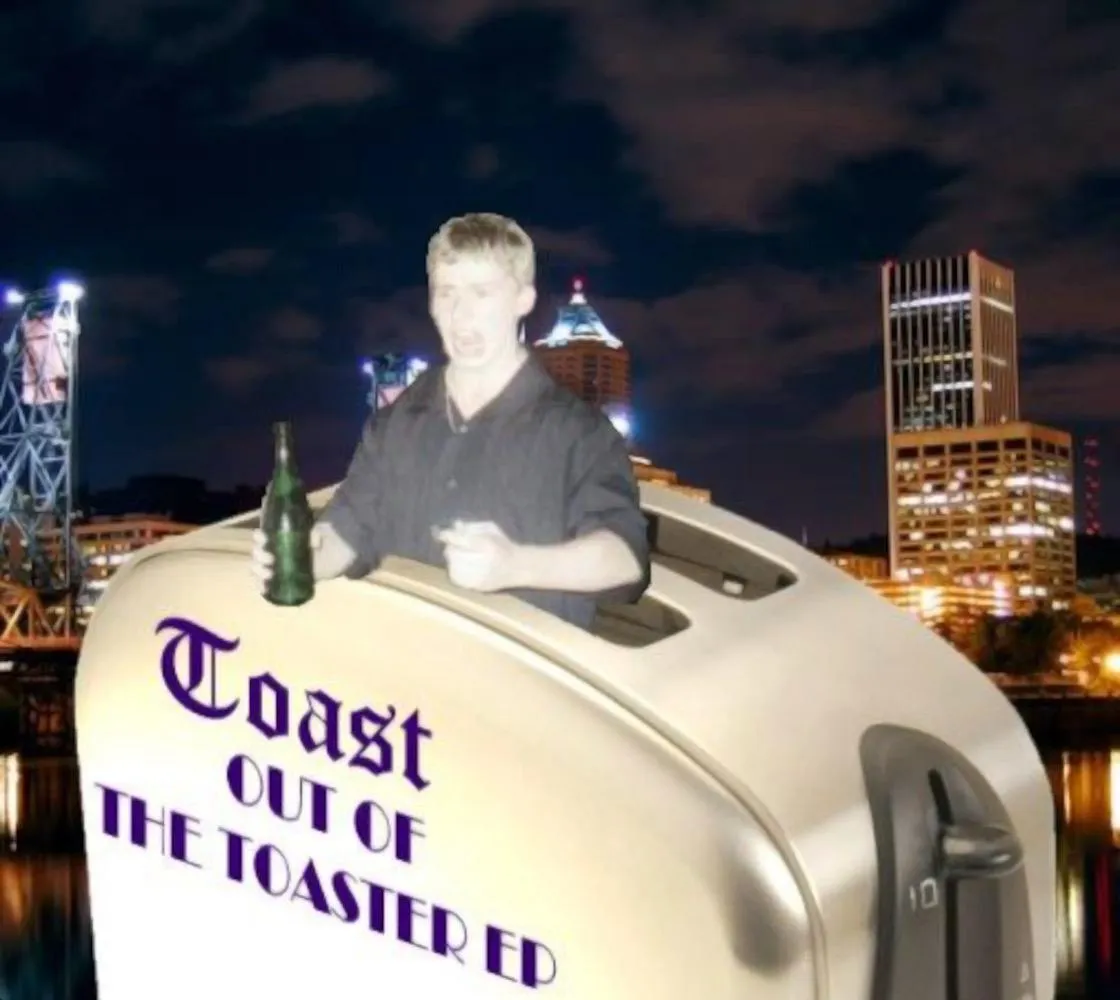
These songs, as well as another Alice Cooper cover I recorded the summer after finishing high school ("No More Mr. Nice Guy," in case you were wondering), comprised what I would later call the Out of the Toaster EP. The cover art, pictured above, and which I never had the patience to print out and insert into the jewel cases in which I handed out the CDs, shows me in a most jovial state, bottle of Martinelli's sparkling cider in hand, popping as it were from a toaster into the fair city of Portland (my family had relocated from Glendale, Arizona in the summer of '03).
I've always liked being onstage.
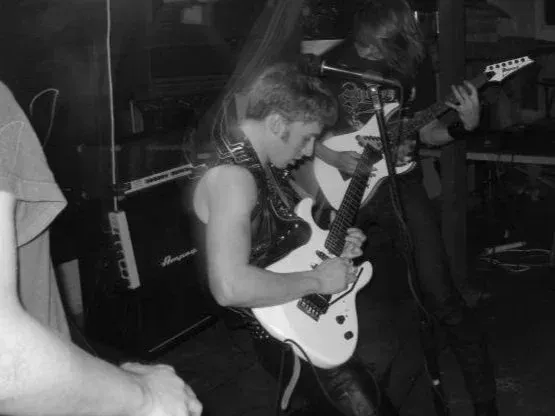
I had been a theater geek in high school, and that translated well to playing in bands afterwards. (Well, sort of. It's actually a bit difficult to sing, play guitar, and physically embody the song all at once, as some embarrassing video footage of me [which has been lost; believe me, I've looked for it, but I have not found it. It's more embarrassing than this, though] shows...) The main thing from my late teens and early twenties was White Lightning, a metal band I joined at the request of a buddy with whom I'd played in a punk band that lasted about three months. White Lightning, from 2006-2009, played mostly around Portland's bar/all-ages venue/basement circuit, as well as a couple of times in Salem, Vancouver, and Olympia. At first we shared the stage with local punk bands, but we soon found our niche in Portland's version of the New Wave of Traditional Heavy Metal, especially among the thrash, death, and black metal bands.
White Lightning was where I cut my teeth as a musician. Listening to my solo recordings (under the name of Captain Thunderpants by this time), it's right around early '07 that the guitar solos start to sound respectable. The other guitarist in the band, Pete Sylvia, was an absolute shredder, and a little of that rubbed off on me. I'm still not at the level he was, but I learned to keep up with him, and it made a difference in my own music.
To make a long story short, though...
White Lightning broke up in 2009, as most bands do (well, they break up, but not always in 2009), and while I tried starting another band a few times, worked odd jobs, and interned in the studio at Cloud City Sound (RIP) for a while, my solo project, rechristened a few times, was what I focused on. I branched out from power metal, took an interest in progressive rock, doom metal, and synthesizers, and I released music online in the sad, quiet, post-MySpace era of the internet. Between '09 and '16 I recorded a couple of EPs, namely Toast and The Barrow Downs (remixed and condensed, at last, into an album in 2026, appropriately called Toast on the Barrow Downs). I also recorded a concept album based on Metroid of mostly instrumental synth rock tracks, called The Hunt, which I released in December, 2016. I still think it's one of the coolest things I've made, and while I may be in the minority, here, I'm willing to die on that hill if you want to fight about it.
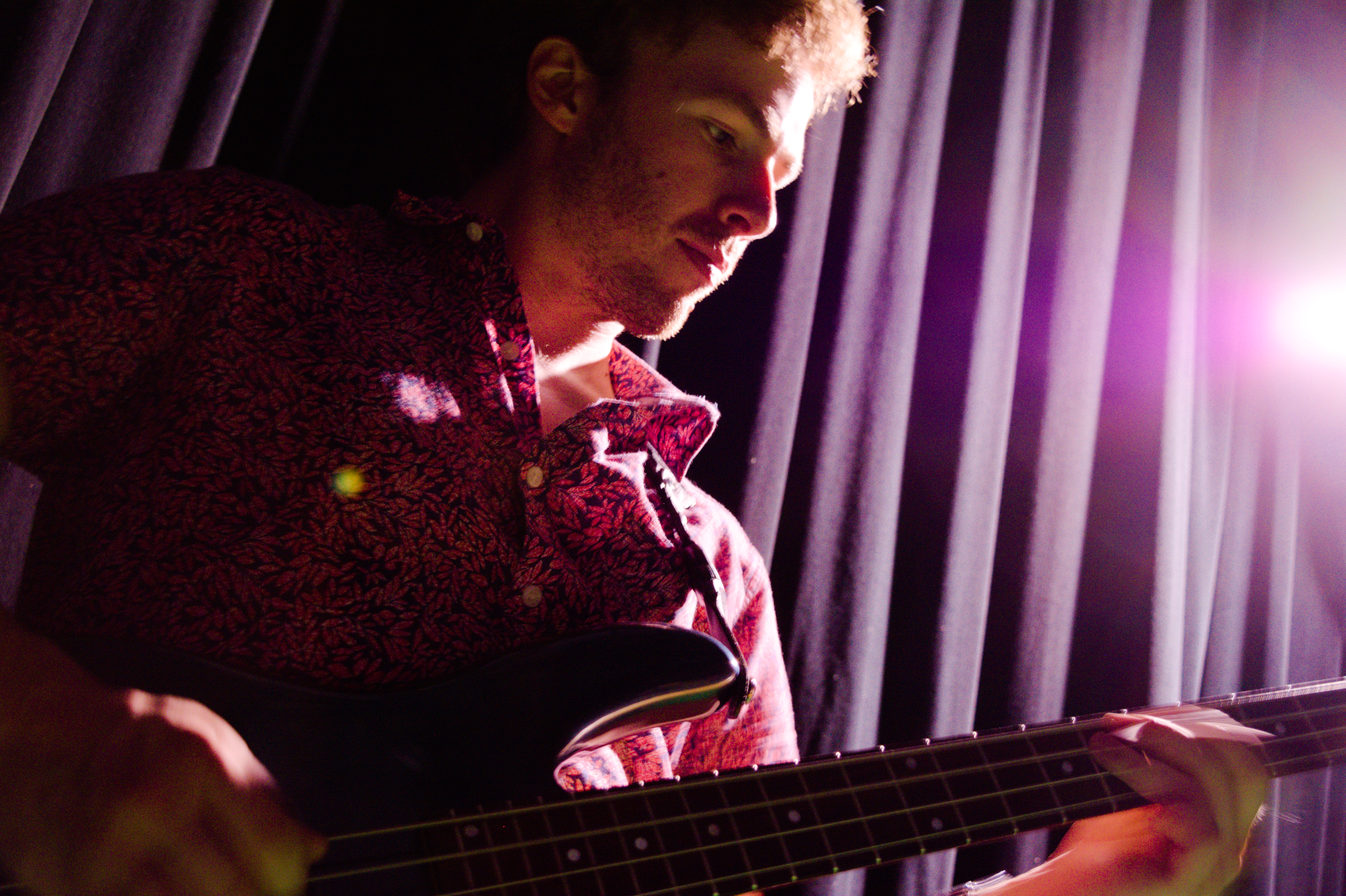
Also in 2016, I went back to school and studied both music theory and vocal performance. While the goal was to become a composer (and on that note, my first commission for an orchestra was debuted at St. Paul's Lutheran Church in Mankato, MN in May, 2022), I got the bug to pick up my recording artist project again, less than a year after graduation, when I heard Wilderun's "Far From Where Dreams Unfurl" for the first time. They blew my mind.
I did some digging into more effective ways to promote my music than I had heretofore used, rechristened my project as "Inire's Mirrors," and released Electric Fugue in February, 2022. Electric Fugue was an album featuring some music I'd written in my recent college years, as well as some songs from afterwards, but all with deliberate use of my classical training: a traditional fugue, but with synths and drums, for the title track; a metal cover of Georges Bizet's "Toreador Song" from Carmen; a piano ballad inspired by early 20th century French composers (think Chausson and Poulenc); and some other originals, most featuring a full orchestra (well, a virtual orchestra using EastWest's Hollywood Orchestra VSTs, anyway).
Since then I've been releasing singles, if a bit more slowly. Getting older and raising a family does make free time rather scarce, after all. Apart from the new music I've been working on and releasing, I also released the first non-DIY physical copy of my music in the form of Toast on the Barrow Downs in 2026, which is sort of my Star Fox 2 (that game was supposed to be released for the Super Nintendo back in the 90s, but one thing led to another and it didn't get released until 2017 on the virtual console for Switch). As I mentioned before, it smashes my Toast (2012) and The Barrow Downs (2014) EPs together, adds a couple of singles I never put on the streaming services (one of them being a speed metal Tiny Tim cover, "Livin' in the Sunlight, Lovin' in the Moonlight," whose original composition went into the public domain in 2026), and gives them a mix that's up to my current standard. If you're in the neighborhood of Mankato, Minnesota, drop by TuneTown and get yourself a copy. If you're in the neighborhood, for that matter, drop me a line at [email protected], and maybe we can get a beer or a coffee or something.
And if you want to keep in the loop on things, read the occasional strange ramblings about my music and other subjects, enter please your email address below, and I will not spam you.


